This is general information, not personalised tax advice. Residence and treaty outcomes depend on your facts.
Do UK non-residents need to file a Self Assessment tax return? Often, yes. Living abroad does not automatically end your UK tax obligations if you retain UK rental income, property, workdays or other UK connections. This 2026 UK non-resident Self Assessment guide covers the 2025/26 tax year, 6 April 2025 to 5 April 2026, and explains filing deadlines, SA109, residence rules and split-year treatment.
1. UK Non-Resident Self Assessment: 101
UK tax residence is assessed separately for each tax year. A non-resident is generally taxed on UK-source income rather than worldwide income, although special rules can apply to UK land, temporary non-residence and treaty claims.
A UK non-resident Self Assessment tax return normally includes the main return and the SA109 residence pages. HMRC's free online filing service does not support non-resident income reporting. You must:
- File a paper return with SA109
- Use Self Assessment software that supports SA109
- Appoint a tax professional
2. Who Must File a UK Tax Return from Abroad?
You will usually need to file a UK tax return from abroad if you receive UK rental income, carry on self-employment in the UK, receive taxable UK savings interest, have other untaxed UK income, or receive an overseas pension after being UK resident in one of the previous five tax years. A double-taxation agreement may change the UK charge or reporting route, but relief should never be assumed.
UK Self Assessment deadlines for 2025/26
Late filing can trigger penalties even where little or no tax is due. UK property disposals have a separate, faster regime: a non-resident disposing of UK property or land generally must report the disposal and pay any Capital Gains Tax due within 60 days of completion.
3. When Do You Become Non-Resident for UK Tax?
There is no single "moving abroad" date that determines residence. Apply the Statutory Residence Test (SRT) for the whole tax year. Start with the automatic overseas tests, then the automatic UK tests, and finally the sufficient ties test if neither set gives an answer.
Consider your UK arrival and departure days, workdays, homes, family connections, available accommodation and recent residence history. Keep contemporaneous travel records, calendars, employment contracts, accommodation evidence and workday logs. A day-count alone can be misleading because the thresholds change with your history and UK ties.
4. Statutory Residence Test for UK Non-Residents
You are automatically UK resident if you spend 183 days or more in the UK. Other automatic UK tests consider a UK home and full-time UK work. The automatic overseas tests can establish non-residence where, broadly, you spend fewer than 16 UK days after recent UK residence, fewer than 46 UK days after three non-resident years, or meet the detailed full-time overseas work test, including fewer than 91 UK days and fewer than 31 UK workdays of more than three hours.
If no automatic test settles the result, the sufficient ties test compares UK days with connections such as family, accommodation, work and prior presence. Exceptional circumstances and the deeming rule can alter the count, so document any unusual disruption carefully.
5. Split-Year Treatment: Rules, Ambiguities and Tax Traps
Split-year treatment is sometimes described as a loophole, but it is a statutory rule, not an elective shortcut. If you are UK resident for the year and meet every condition of one of the eight prescribed cases, the year is divided into a UK part and an overseas part. For most purposes, you are treated as resident in the UK part and non-resident in the overseas part.
The difficult areas are factual: when full-time overseas work starts, when a UK home ceases to be available, whether an overseas home exists, how partners' circumstances interact, and which case takes priority where more than one applies. The split date can materially affect foreign earnings, investment income and gains.
Other commonly misunderstood planning points include double-taxation relief, eligibility for the UK Personal Allowance and the treatment of certain investment income. These are reliefs or computational rules, not blanket exemptions. A British citizen, qualifying EEA citizen, qualifying UK government worker or person protected by an applicable treaty may be entitled to a Personal Allowance. Claiming one treatment can affect another, so compare the complete calculation rather than focusing on a single relief.
Temporary non-residence is another major trap. If you return after a short absence, certain gains or income realised while abroad may be brought into charge in the year of return. For the 2025/26 rules, the framework broadly looks at prior sole UK residence and whether the non-resident period exceeds five years.
6. UK-Source Income Non-Residents Must Review
Common UK-source items for non-residents include:
- Profits from UK property, including rent received under the Non-Resident Landlord Scheme
- Earnings for duties physically performed in the UK and profits from a UK trade
- UK pensions, savings interest and dividends, subject to domestic rules and any treaty
- Gains on direct or certain indirect disposals of UK land
- Income or gains affected by temporary non-residence
Do not assume tax withheld at source completes the position. Check whether a return, repayment claim, treaty claim or separate property-disposal report is needed. Where both countries tax the same income, the relevant double-taxation agreement may allocate taxing rights or provide a credit.
7. How Signofy Supports UK Non-Resident Tax Returns
Signofy is a purpose-built AI-native cross-border tax platform for UK expats, designed to provide one view across multiple jurisdictions. Its features include automated cross-border filing, bookkeeping, deadline and compliance alerts, double-taxation agreement support, document uploads, tax insights, and exportable reports.
For UK non-residents, that approach can help organise tax evidence, classify income by jurisdiction, monitor deadlines and auto apply double taxation relief where more than one country is involved. Signofy helps automate your cross-border tax management and filing and takes the admin and panic out of your tax journey. Availability and suitability should be confirmed for your residence country and circumstances.
Frequently Asked Questions
Can a non-resident file Self Assessment online?
Not through HMRC's free online service where non-resident reporting and SA109 are required. Use a paper return, compatible commercial software or a tax professional.
Do I need SA109 if I live abroad?
You will generally need the SA109 residence pages when declaring non-resident status, claiming split-year treatment or reporting other relevant residence details with your Self Assessment return.
Do UK non-residents pay tax on rental income?
UK property profits generally remain within UK tax. The Non-Resident Landlord Scheme affects how rent may be paid and tax withheld, but it does not necessarily replace the annual Self Assessment obligation.
Does moving overseas automatically make me non-resident?
No. Your position is determined under the Statutory Residence Test using UK days, work patterns, homes, ties and prior residence history.
Conclusion
Non-residence can narrow the UK tax net, but it rarely makes UK compliance disappear. Establish your SRT position first, test split-year treatment carefully, identify every UK-source item, and review treaties and temporary non-residence before filing. If not sure how and where to start, you can take help from purpose built platforms like Signofy to streamline your UK expat taxes.
Practical checklist
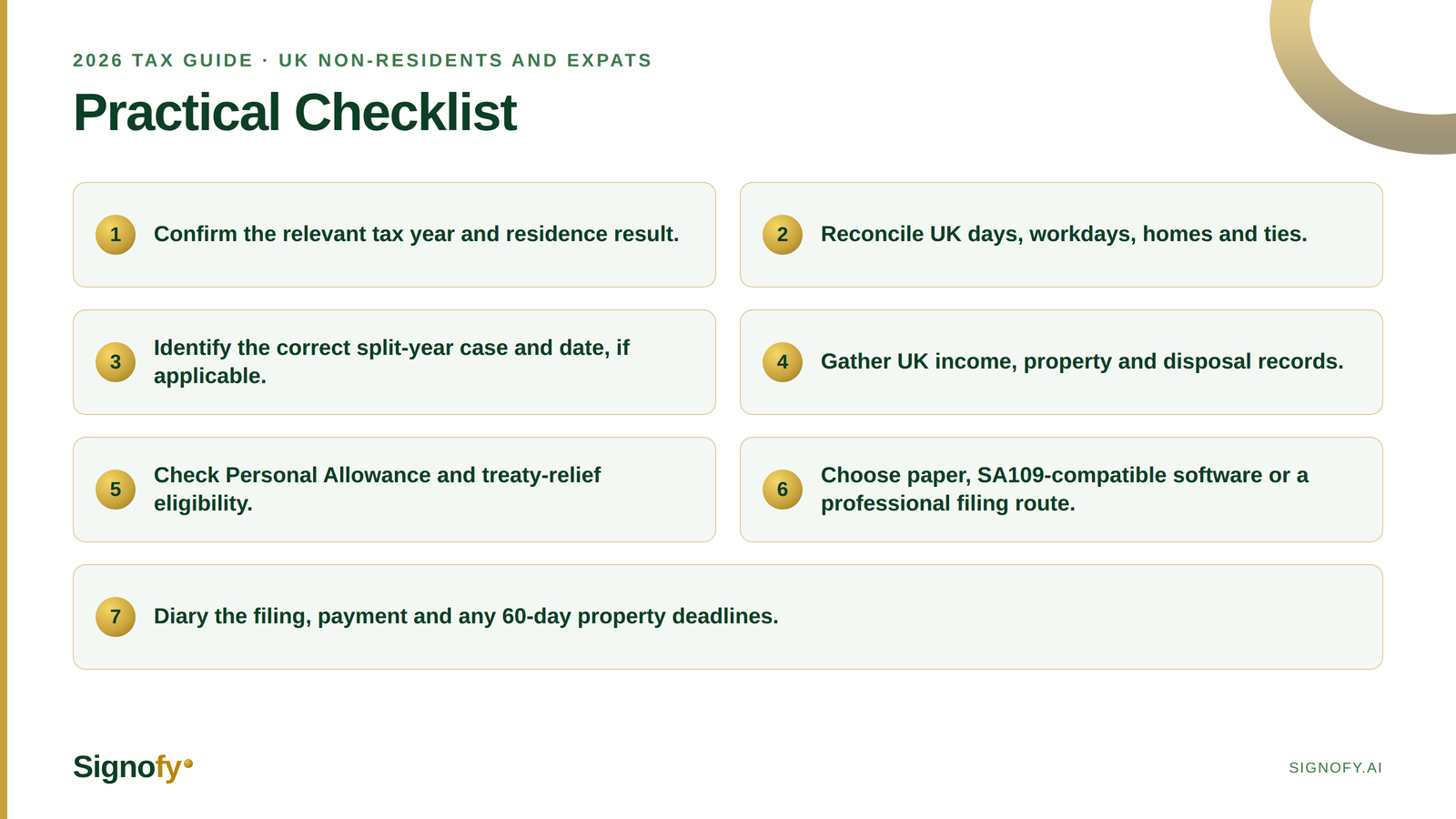
- Confirm the relevant tax year and residence result
- Reconcile UK days, workdays, homes and ties
- Identify the correct split-year case and date, if applicable
- Gather UK income, property and disposal records
- Check Personal Allowance and treaty-relief eligibility
- Choose paper, SA109-compatible software or a professional filing route
- Diary the filing, payment and any 60-day property deadlines
Ready to simplify your UK expat taxes?
Join your peers already on the waitlist for AI-native cross-border tax management.
Get Free Lifetime AccessTax rules and their application can change. Review current HMRC guidance and obtain professional advice for complex or high-value matters.