This article provides general information, not personalised tax or legal advice. Treaty provisions, domestic laws and filing requirements vary by country and tax period. Seek qualified cross-border advice before acting.
1. What is DTAA for NRIs?
DTAA stands for Double Taxation Avoidance Agreement. It is a treaty between two countries that allocates taxing rights and provides relief when income falls within both countries' tax systems. For NRIs, an applicable Indian treaty can limit source-country tax or support relief in their residence country. DTAA does not automatically make Indian income tax-free or remove tax-return obligations.
2. Why should NRIs understand double taxation relief?
India generally taxes non-residents on Indian-source income. Their residence country may also require reporting and tax on that income. Common examples include Indian rental income, Non-Resident Ordinary (NRO) account interest, dividends and capital gains. Even income exempt in India can be taxable abroad. Understanding DTAA relief helps NRIs identify eligible credits, avoid excess tax deducted at source (TDS) and coordinate filings across countries.
3. How does DTAA reduce double taxation for NRIs?
- Reduced withholding: An eligible treaty provision may cap source-country tax on income such as interest or dividends.
- Foreign tax credit: The residence country may credit eligible Indian tax against its tax on the same income, subject to limits.
- Exemption: Some provisions allocate exclusive taxing rights or require one country to exempt specified income.
Example of foreign tax credit: Suppose eligible Indian tax on an income item is ₹15,000 and residence-country tax before credit is ₹25,000. If the full Indian tax qualifies for credit, another ₹10,000 is payable abroad. Total tax is ₹25,000 rather than ₹40,000. This hypothetical example assumes full credit eligibility, not a particular treaty rate. Timing, income classification and credit limits can change the result.
4. How to claim DTAA relief: documents and pitfalls
Think of DTAA as a compliance framework, not a tax loophole. Follow this checklist before requesting a treaty rate or claiming credit:
- Confirm tax residency. Check both countries' rules for the relevant period. An overseas address or Indian passport does not establish treaty eligibility by itself.
- Identify the income and treaty article. Interest, rent, pensions and capital gains can follow different rules. There is no single DTAA tax rate for all NRIs.
- Obtain a Tax Residency Certificate (TRC). Request it from your residence-country tax authority and ensure it covers the relevant period. Keep your foreign Tax Identification Number (TIN) available.
- Check Form 41 versus Form 10F. Under the 2026 rules, Form 41 succeeds Form 10F. Official guidance requires annual filing when claiming DTAA benefits, with the TRC uploaded. Form 10F remains relevant to earlier periods, including income for FY 2025-26 assessed in AY 2026-27. Match the form to the applicable tax period.
- Prepare before withholding. Give the payer the required treaty documentation early. Excess TDS may require an Indian return and refund claim; withholding is not always the final tax liability.
- Claim credit in the correct country. An NRI seeking residence-country credit for Indian tax must follow that country's procedure. Do not assume India's foreign-tax-credit process is the right route.
- Keep evidence and check restrictions. Retain income statements, TDS certificates and tax-payment records. Review deadlines, credit caps and applicable anti-abuse rules. Artificial arrangements can lose treaty protection.
5. Common questions about DTAA relief for NRIs
Is DTAA relief automatic? No. You must meet the relevant treaty conditions and provide required documentation. Does DTAA make NRO interest tax-free? Not automatically. An eligible treaty may reduce Indian withholding, while residence-country tax can still apply. Can NRIs recover all Indian tax abroad? Not necessarily. Foreign tax credits are subject to local rules and limits, often linked to the residence-country tax on the same income.
6. Key documents to keep when claiming foreign tax credit in your country of residence
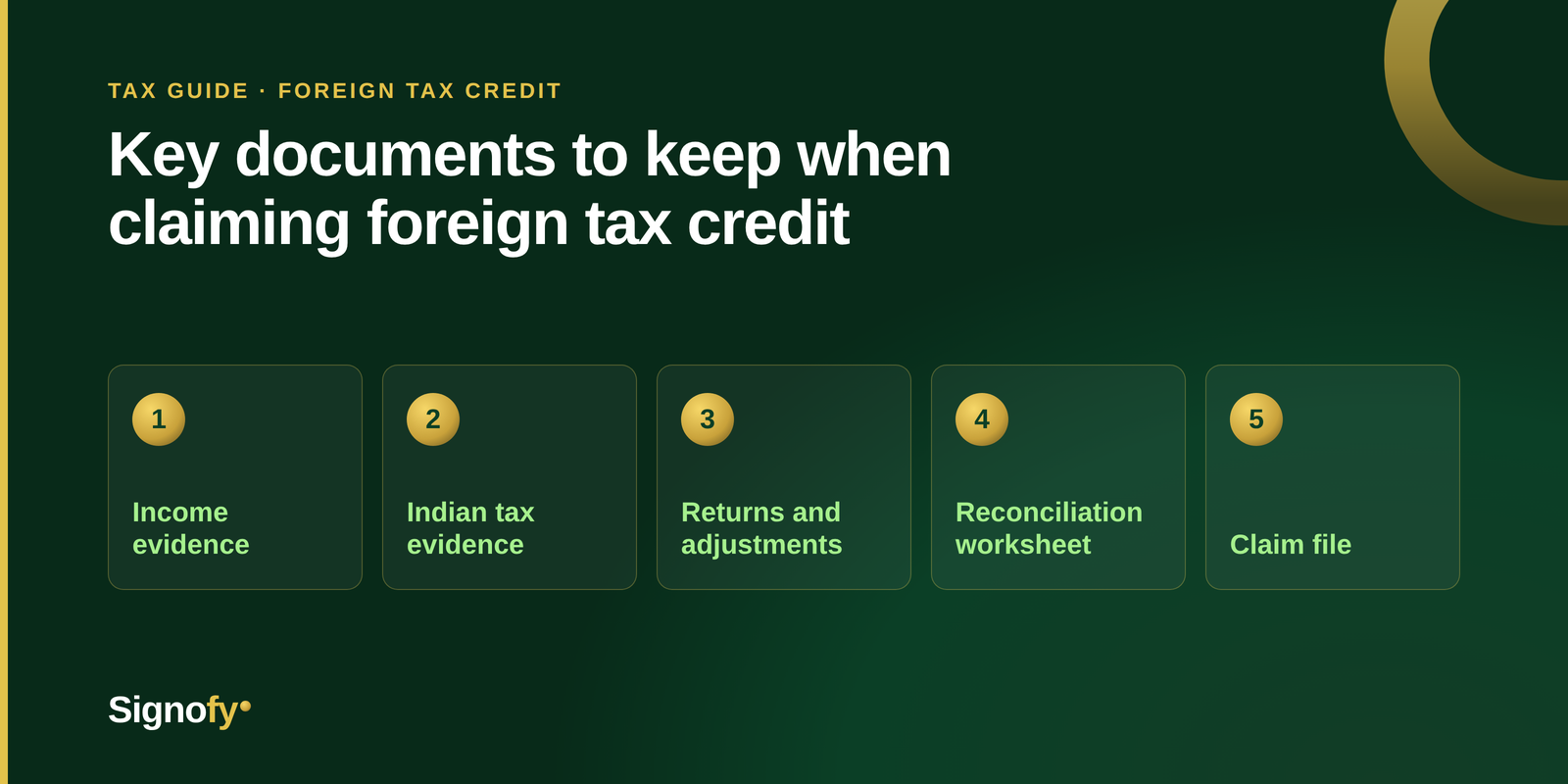
Keep a clear evidence trail linking Indian income to the tax paid on it. This practical checklist is not a universal list of mandatory attachments:
- Income evidence: Bank interest certificates, rental statements, dividend vouchers and capital-gains calculations.
- Indian tax evidence: Applicable TDS certificates, annual tax statements for the relevant period, tax-payment challans and bank payment confirmations.
- Returns and adjustments: Indian returns, acknowledgements, tax computations, assessment notices and refund records. A later refund may require a credit adjustment.
- Reconciliation worksheet: Match each income item to its tax, payment dates, tax year and currency conversion. Keep exchange-rate sources and credit calculations.
- Claim file: Retain residence-country returns, credit schedules and relevant treaty calculations.
Check your residence country's filing, translation and record-retention rules. A TRC supports treaty residency but does not itself prove Indian tax paid. Excess withholding is not automatically creditable.
7. How can Signofy streamline DTAA relief for NRIs in one place?
Signofy is designed to bring cross-border tax calculations, documents and filing workflows into one place. For NRIs, the goal is simple: less spreadsheet juggling, fewer missing records and less last-minute panic when preparing a DTAA relief claim.
- DTAA calculations: Bring income data, tax computations and applicable double taxation relief into a connected workflow.
- Document management: Upload statements and supporting records together, with data extraction and searchable organisation reducing manual entry.
- Reconciliation: Keep income, tax deductions and payment evidence together for comparison, making gaps easier to identify before filing.
- Claim file: Bring supporting documents and calculations together for review, rather than rebuilding the evidence trail at the deadline.
With organised records and proactive alerts, Signofy aims to replace deadline-driven admin with year-round cross-border tax preparation and management.
8. Conclusion: claim DTAA benefits with confidence
DTAA relief for NRIs starts with four essentials: the right residency status, the right treaty article, complete documentation and a valid relief claim. Review both countries' requirements before payments and filing deadlines. A coordinated cross-border tax process can help you avoid missed benefits without confusing lawful relief with guaranteed tax exemption.
Ready to simplify your DTAA relief claim?
Join NRIs already on the waitlist for AI-native cross-border tax management.
Get Free Lifetime AccessThis article provides general information, not personalised tax or legal advice. Treaty provisions, domestic laws and filing requirements vary by country and tax period. Seek qualified cross-border advice before acting.