General information, not personalised tax or investment advice. Rules and deadlines depend on your circumstances and tax year; confirm them before acting.
Two countries. Two accountants. Two platforms. Yet you are still chasing statements, explaining the same transactions twice and worrying about what someone missed. For many expats, India–UK cross-border tax management means duplicated fees without a joined-up picture.
The better approach: assess tax residency in both countries, organise one set of records, review income and asset sales across both systems, claim eligible double taxation relief and track filing and payment deadlines together. Here is how to turn that into a year-round routine.
1. Why is India–UK Expat Tax Filing so Complicated?
The problem is fragmentation: separate document requests, different tax years and advisers looking at only one side of your finances. You become the coordinator. A return filed correctly in one country does not, by itself, settle your obligations in the other. The goal is not simply two completed returns. It is one coordinated cross-border tax process.
2. Five India–UK Tax Myths Expats Should Stop Believing
- "My Indian tax-free investments are tax-free in the UK." An Indian exemption does not automatically transfer overseas. UK residents normally face UK tax on foreign income, subject to applicable reliefs. Check each investment's UK treatment rather than relying on its Indian label.
- "I only file where I live." Residence is not the only factor. Indian rent, investment income or gains can create Indian obligations while you live in the UK. Assess filing requirements separately in each country.
- "The India–UK DTAA automatically exempts asset sales." The India–UK Double Taxation Avoidance Agreement allocates taxing rights and provides relief; it is not a blanket capital gains exemption. Both countries may tax a transaction, with eligible credit relief subject to conditions and limits.
- "Old UK investments stay exempt when I return to India." Buying an asset before returning does not automatically exempt its future income or gains. Indian resident and ordinarily resident taxpayers generally face tax on worldwide income. Resident but not ordinarily resident (RNOR) status can narrow that scope, subject to conditions.
- "Keeping Indian income offshore avoids UK tax." The remittance basis ended on 6 April 2025. Eligible new residents can claim the four-year foreign income and gains (FIG) regime, generally after ten consecutive non-UK-resident tax years. Relief requires a claim and can involve losing allowances.
3. How Can You Streamline India–UK Cross-Border Taxes?
- Maintain a travel log. Record entry and exit dates, workdays and supporting evidence. Apply each country's residency rules annually; do not reduce the assessment to a single "183-day rule".
- Create one secure tax document folder. Keep payslips, bank and investment statements, purchase costs, sale confirmations, rental records, tax returns and proof of tax paid together. Give advisers controlled access rather than emailing duplicate files.
- Check tax before selling an asset. A property sale, share disposal or fund redemption may need review in both jurisdictions. Ask about capital gains, withholding, exchange rates, reporting and relief before committing, not after the proceeds arrive.
- Keep residency details current. Update residential status and contact information on India's Income Tax e-Filing portal where appropriate. Ensure each return reflects the correct annual status; changing a profile does not determine legal tax residence.
- Coordinate foreign tax credit claims. Retain evidence of overseas tax and reconcile the same income across both returns. Check the applicable claim process, including Form 67 guidance for relevant Indian assessment years, and year-specific requirements.
- Use tools without outsourcing judgement. Use tools like Signofy to centralise records, track residency, get real time tax insights and calculation across both jurisdictions in one place and key reminders, but also seek qualified cross-border advice for complex residency, pensions, large disposals or disputed treaty treatment.
4. Which India and UK Tax Deadlines Should Expats Track?
4.1 UK tax deadlines
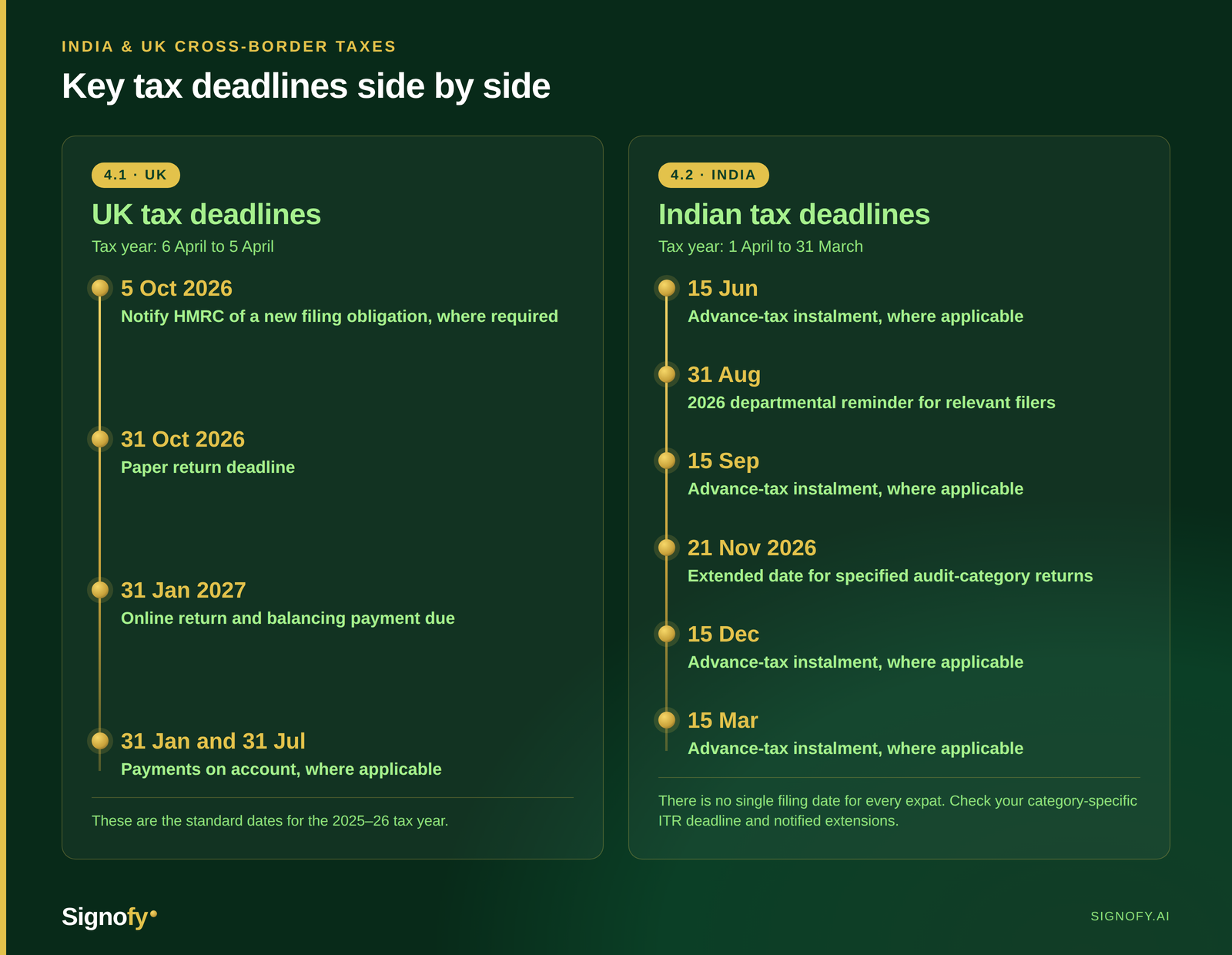
The tax year runs from 6 April to 5 April. For 2025–26, the standard Self Assessment deadlines are 5 October 2026 to notify a new filing obligation where required, 31 October 2026 for paper returns, and 31 January 2027 for online returns and balancing payments. Payments on account, where applicable, fall on 31 January and 31 July.
4.2 Indian tax deadlines
The tax year runs from 1 April to 31 March. Standard advance-tax instalments, where applicable, fall on 15 June, 15 September, 15 December and 15 March. Check your category-specific ITR deadline and official deadline updates: 2026 departmental reminders included 31 August for relevant filers, while specified audit-category returns were extended to 21 November 2026. There is no single filing date for every expat.
5. How Can Signofy Simplify Your India–UK Expat Taxes?
You should not have to become the project manager for your own cross-border taxes. At Signofy, we're building one place to organise your India–UK tax admin: upload documents in bulk, bring your tax information into a unified view and spend less time repeating the same details across disconnected workflows.
Our smart document categorisation, personalised tax insights, built-in DTAA reliefs and compliance alerts are designed to help you organise records, understand what needs attention and stay ahead of deadlines. The aim is less chasing, less duplicated admin and a clearer picture across both countries, not another platform for you to manage. We also help expats who work with accountants or tax consultants keep up with ongoing document requests and questionnaires, reducing document chasing, email fatigue, and last-minute panic.
6. Conclusion: Manage Two Tax Systems with One Coordinated Plan
Managing India–UK expat taxes starts well before filing season. Track travel, organise evidence, review asset sales early and coordinate relief claims. A joined-up process can reduce duplicated admin and last-minute surprises. With Signofy, our aim is to give you an always-on tax assistant: a clearer view of your tax position across both jurisdictions, support with tracking residency and insights to help you plan ahead. Remember, managing your cross-border taxes is not just a year-end task; it requires ongoing organisation and planning to stay on top of your tax obligations.
Ready to simplify India–UK tax management?
Join your peers already on the waitlist for AI-native cross-border tax management.
Get Free Lifetime AccessTax rules and their application can change. Review current HMRC and Income Tax Department guidance and obtain professional advice for complex or high-value matters.