Your competitor just dropped a new pricing page. Three of your top deals slipped last quarter to the same rival. A key feature they launched two months ago is now showing up in your deal notes.
You probably already knew most of this. But did you know it was fast enough? Did you know why it mattered? And did it actually change how your team went to the market?
That gap between knowing about your competitors and acting on what you know is the real competitive intelligence problem in 2026. And it's the one most GTM and product marketing teams haven't solved yet.
1. What Is Competitive Intelligence?
Competitive intelligence (CI) is the practice of collecting, analyzing, and activating information about your market, competitors, and buyers to make faster and smarter GTM decisions.
In its traditional form, CI meant commissioning analyst reports, manually reviewing competitor websites, and building static battlecards that sat in a shared folder no one updated. It was slow, resource-intensive, and inevitably backward-looking.
That model is dead.
In 2026, competitive intelligence spans multiple data layers: win/loss patterns from your CRM, sales call transcripts, competitor website and pricing changes, G2 and Capterra review sentiment, LinkedIn content shifts, and product release signals, all happening simultaneously, across dozens of competitors, every single day.
The challenge is no longer access to competitor information. It's making sense of all of it.
2. The Real Challenges with Competitive Intelligence Today
Despite the explosion of available data and AI tooling, most CI programs still struggle with the same foundational problems.
2.1. Data collection without decision-making context
Most teams have no shortage of competitor information. What they lack is the connective tissue that turns raw data points into insight. Knowing that a competitor launched a new feature is interesting. Understanding that the feature is directly tied to the deals you lost last month that's intelligence.
The real value of competitive intelligence isn't knowing where competitors stand today, but understanding how their position is changing, why it's changing, and what that signal about their strategy. Most CI programs capture the first part and miss the rest entirely.
2.2. Legacy CI tools are repositories, not intelligence engines
Legacy CI platforms built their reputation on battlecard creation and competitor monitoring. They're useful, but they were fundamentally designed to store competitive information, not to connect it.
These tools are also built around just building battlecards and pushing competitive context to reps. That's a step forward. But the deeper question is why we are losing deals to this competitor specifically, and what has changed in the last 90 days across their pricing, messaging, reviews, and product still requires human analysts to pull together.
2.3. AI tools lack historical context
This is the limitation most GTM teams discover too late. You can ask Claude or ChatGPT to scan a competitor's website and summarize their positioning. You can ask for it to compare pricing pages, analyze feature announcements, or draft a battlecard. It will do all of this well.
What it cannot do is tell you whether that competitor changed their pricing in the last three months, whether their review sentiment on G2 has shifted since Q1, or whether the messaging on their homepage today is materially different from six weeks ago.
LLMs have no persistent memory across sessions and no access to historical data. They are exceptional research assistants for point-in-time analysis. They are not, by design, a continuous competitive intelligence system.
2.4. The analyst bottlenecks
Even when teams want to run deeper analysis, drawing themes across win/loss data, correlating competitor activity with pipeline movement, identifying trends across review platforms, they hit the same wall: it requires dedicated analyst time. Data ingestion, pipeline building, cross-source correlation, all this is specialist work. Most CI and PMM teams don't have it, and in 2026, PMM teams are getting smaller rather than larger, with the overall assumption that AI will allow smaller teams to absorb expanded mandates. The resource gap is real, and it's widening.
3. How AI Is Reshaping Competitive Intelligence and Where It Falls Short
There's no question that AI has fundamentally changed what's possible for competitive intelligence. PMMs using AI strategically to synthesize competitive intelligence, model pricing scenarios, build ICP frameworks, generate positioning hypotheses for testing are using tools to expand what they can do, not to do the same thing faster.
Here's an honest breakdown of where AI genuinely helps, and where the limitations kick in.
Where AI excels in CI:
- Secondary research at speed. What once took a junior analyst two days scanning competitor websites, summarizing product pages, pulling review themes now takes minutes. This is a genuine step change.
- Structured output on demand. If you define a template for how you want competitive insights formatted, say, a standard battlecard structure with positioning, objection handling, and differentiation, you can prompt Claude or ChatGPT to match that format every time. Using custom instructions or Claude Skills (reusable prompt templates), you can build consistency into your CI outputs without starting from scratch each session. You can watch this video if you want to understand how you can build Claude skills.
- Hypothesis testing. Asking "does our new pricing tier compare favorably against competitors X, Y, Z based on their current website?" is a valid and useful AI-assisted question. You'll get a fast, structured answer.
Where AI falls short:
- Historical tracking. "Have any of my competitors changed their pricing in the last three months?" is a question AI cannot answer. It has no memory of what a competitor's website looked like 90 days ago. It has no access to the delta between then and now.
- Cross-source correlation. Spotting that a competitor's negative review spike on G2 coincides with a messaging pivot on their homepage, which correlates with your win rate improving in that segment that pattern requires persistent data, not a one-shot prompt.
- Deal-level intelligence. Connecting competitive signals to actual pipeline outcomes, which competitor moves are costing you deals, which aren't is beyond the reach of general-purpose LLMs.
If your competitive intelligence program cannot tell you how AI tools describe your category's leaders, it is already outdated. But equally, if your CI program is just a collection of ChatGPT-generated battlecards with no persistent signal layer underneath it, you're still operating without a real competitive edge.
4.Key Recommendations for CI and PMM Teams in 2026
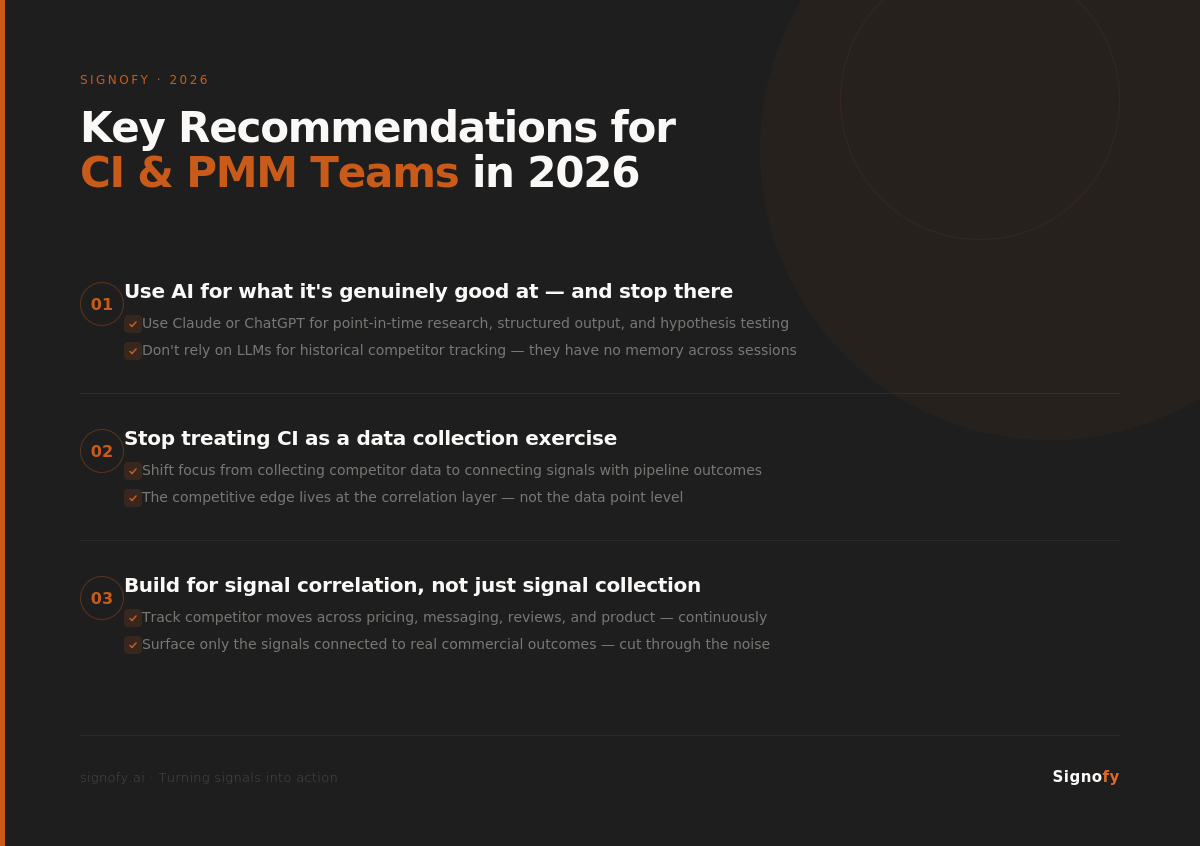
4.1. Use AI for what it's genuinely good at and stop there
Claude and ChatGPT are excellent tools for one-time secondary research, competitive hypothesis testing, and structured output generation. Use them accordingly.
A useful prompt: "Can you scan the websites for competitors X, Y, Z and compare their current pricing tiers against ours? Output it in the following format: [attach format]." That's a strong use case — fast, structured, directly actionable.
A problematic prompt: "Have any of these competitors changed their pricing in the last three months?" That question requires historical context that general-purpose LLMs simply don't have. Knowing their current pricing is not the same as understanding what changed, when, and why. This is the key reason why we purpose-built Signofy Competitive Intelligence Platform that provides context, cross-source competitive intelligence that CI and PMMs need to make sense of the competitor's insights.
The distinction matters because over-relying on AI for CI creates a false sense of coverage. You have data. You may not have intelligence.
4.2. Stop treating CI as a data collection exercise
AI-powered market intelligence is becoming indispensable for PMMs, enabling more precise positioning and faster go-to-market strategies. But the teams winning in 2026 are not the ones with the most competitor data. They're the ones who have built a system for connecting signals across sources.
A competitor launching a new feature is a data point. That same competitor's feature appearing in your loss notes, coinciding with a review of sentiment shift and a messaging update on their homepage that's intelligence. The difference between the two is the ability to correlate signals over time, across sources, in the context of your own pipeline.
Most teams are still running CI at the data point level. The competitive edge lives in the correlation layer.
4.3. Build for signal correlation, not just signal collection
In 2026, your competitors are generating signals continuously product releases, pricing updates, content strategy shifts, hiring moves, review responses, and sales messaging changes. The volume is not a problem. The noise is.
The CI program that creates durable competitive advantage are the ones that can cut through the noise and surface what actually matters: the signals that are connected to real commercial outcomes. Which competitive moves are influencing deals? Which messaging shifts are landing with your shared buyers? Which feature launches are changing the conversation in your category?
Answering those questions requires a system with persistent memory, cross-source data ingestion, and the ability to draw themes across time not a one-shot AI prompt.
5. Final Thoughts
Competitive intelligence has never been more accessible or misunderstood.
The barrier to knowing about your competitors is essentially zero in 2026. A well-constructed Claude prompt and 20 minutes will get you a reasonable overview of any competitor's positioning, pricing, and product claims. That's genuinely useful for a point-in-time check or a quick hypothesis test.
But a competitive edge doesn't come from knowing what your competitors say on their website today. It comes from understanding how they're moving, why buyers are responding to those moves, and what that means for how you position, message, and sell, informed by real data, updated continuously, and connected across sources.
Today's potential customers might not even go to Google to search for your category. They might ask an AI chatbot for a personalized recommendation, and if that AI mentions your competitor but leaves you out, you've lost that customer before they even hit a search engine.
The same principle applies to CI itself. If your competitive intelligence program only captures what's visible today, you're already behind.
The teams that win in 2026 aren't the ones collecting the most data. They're the ones who've built the infrastructure to turn competitive signals into connected intelligence and connected intelligence into GTM decisions.
That's the standard worth building toward.