Your sales team just lost a deal. The prospect's reason: "We found pricing on your website that didn't match what your account executive told us." Nobody lied. Nobody tried to deceive anyone. The website was just... out of date.
This is content drift, and it's quietly costing GTM teams more revenue than almost anyone is tracking.
1. The Problem No One's Watching
Most GTM teams pour enormous energy into creating new content. New battlecards for the latest competitor move. New positioning when the product roadmap shifts. New messaging when a campaign launches. New release notes every sprint. The content creation engine never stops.
But almost nobody is watching what happens to that content after it ships. Nearly half of sales enablement professionals say 40%-100% of their content library needs a refresh, according to research from Spekit, which means reps are routinely working from materials nobody has reviewed in months. Forrester puts the unused share of marketing-created sales content even higher, estimating 60% - 70% percent goes untouched, often because nobody can confirm it's still accurate. That's not a usage problem. It's a trust problem, and trust problems compound the longer they go unaddressed.
Here's the pattern: a new policy goes out. A sales deck gets refreshed. Positioning and messaging evolve. And almost immediately, a quiet problem starts compounding: your team has no reliable way to know where the old version still lives. It's in a shared drive folder three clicks deep. It's cached on a partner's microsite. It's in a PDF an AE downloaded six months ago and still attaches to every email. It's on a support page nobody thought to update because "that's not really sales content."
Without a system to track what exists and where, the only way you find out something's stale is when someone tells you, and by then, the damage is usually already done. A prospect builds their business case around outdated pricing. A customer reads an old release note and assumes a feature still works the way it used to. A new rep pulls the wrong battlecard from a folder because there are three versions and no clear "latest."
None of these are content creation problems. They're content orchestration problems, and almost no GTM team has a system built to catch them.
2. Why This Keeps Happening
It's not a discipline problem. It's a structural one.
Every time a new policy, sales deck, or piece of positioning gets created, it triggers a wave of downstream updates that has to happen across dozens of assets and channels: website pages, sales decks, battlecards, onboarding materials, help center articles, partner enablement docs, internal wikis. Each of those lives in a different tool, owned by a different team, updated on a different cadence.
There is no single source of truth that cascades automatically. Instead, there's a source of truth that exists in someone's head, or in a Slack message, or in a doc that three people edited and two people never saw. Everyone downstream is left guessing whether what they have is current.
The result shows up in three distinct but related ways:
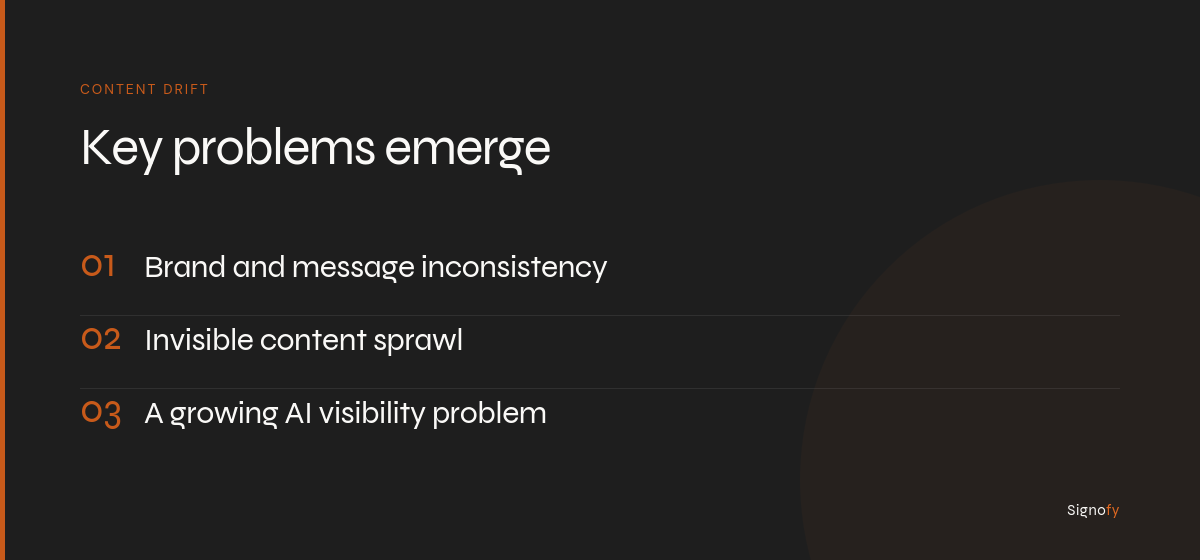
2.1 Brand and message inconsistency. Marketing says one thing on the homepage. Sales says something slightly different on a call. Support describes the product in language that doesn't match either. None of it is intentional, it's just drift, accumulating asset by asset, channel by channel, until the prospect notices before you do.
2.2 Invisible content sprawl. You genuinely don't know everything that exists about your product, scattered across every channel, until a customer or prospect surfaces it for you. And by the time they do, it's already cost you something: a stalled deal, a confused buyer, a support ticket that should never have been a support ticket, a renewal conversation that starts on the back foot.
2.3 A growing AI visibility problem. This one is newer, and most GTM teams haven't caught up to it yet. Buyers increasingly research vendors through AI search and chat tools before they ever talk to a rep, and those tools synthesize whatever is publicly available: your website, your G2 reviews, your help center, your old comparison pages. If your pricing page, your integration list, or your positioning has drifted out of sync with what your sales team is actually saying, AI tools don't reconcile that confusion. They repeat it, often to a prospect who never gives you the chance to correct it on a call.
3. What Content Orchestration Actually Means?
Content orchestration is the discipline of cascading your source of truth across every asset and channel, so that anyone interacting with your brand (internal teammates, prospects, or existing customers) always finds the current version. Not the version from two quarters ago. Not the one that's technically still live but quietly wrong. The current one.
It's the difference between creating content and maintaining content as a living system. When a policy changes, orchestration means that change doesn't stop at the announcement; it propagates outward until every asset referencing that policy reflects it. When pricing updates, every deck, every page, every battlecard that mentions pricing gets flagged and corrected, not eventually, but as part of the update itself.
Think of it less like publishing and more like version control for your entire GTM content footprint, one where the "latest commit" is automatically reflected everywhere, instead of manually copy-pasted into a dozen disconnected places and hoping someone remembers the last one.
4. The Business Case for Getting This Right
The benefits aren't abstract. They show up directly in pipeline and retention.
4.1 Brand consistency. When every asset reflects the same source of truth, your brand stops fragmenting across touchpoints. A prospect who reads your website, sits through a demo, and later talks to support hears one coherent story instead of three slightly different ones.
4.2 Messaging alignment across sales and marketing. Reps stop improvising because they're not sure which deck is current. Marketing stops fielding "wait, is this still accurate?" questions from the field. Everyone is working from the same playbook, because there's only one playbook.
4.3 Always-on-brand sales assets. Sales teams move fast and don't have time to audit their own materials before every call. Orchestration means the assets they reach for are already correct, without anyone having to manually check.
4.4 Automated content audit. Instead of a quarterly fire drill where someone manually reviews every asset (and inevitably misses half of them), the audit becomes continuous and automatic, with gaps and inconsistencies surfacing as they appear, not months later.
4.5 Stronger AI search visibility. As more buyers research through AI tools before ever reaching a rep, having one consistent, current source of truth across your public assets isn't just a brand nicety anymore. It's what determines whether AI search engines describe you accurately or repeat whatever stale, conflicting version of your story happens to rank.
4.6 No deals lost, no churn driven by inconsistency. This is the bottom line that matters most to revenue leaders. When a prospect's last impression before signing is "your materials don't agree with each other," that's not a content problem anymore, it's a trust problem, and trust problems kill deals. The same logic applies to renewals: a customer who feels like they're being given outdated information starts wondering what else is outdated.
5. How to Actually Automate This?
The honest answer is that most teams can't solve content orchestration manually at scale. Revenue teams already burn an estimated 440 hours a year just searching for or recreating assets buried in shared drives, and that's before anyone tries to audit whether those assets are even current. The surface area is too large, with too many assets, too many channels, too many owners, for a person or even a small team to track reliably. Spreadsheet-based content audits go stale the moment they're finished.
This is the gap tools like Signofy are built to close. Instead of relying on someone to remember every place a piece of content lives, Signofy treats orchestration as a continuous process tied to your source of truth.
Here's what that looks like in practice: every time you create or update a policy, battlecard, positioning statement, messaging framework, or product name, Signofy scans across your connected assets, including drives, your website, product release pages, and support and help center pages, to find every place that change should ripple through. It identifies the gaps, surfaces recommended updates, and once you approve them, pushes the changes through to the relevant assets.
That turns a process that used to be audit, then manual review, then a scramble of individual updates across a dozen tools into a single connected workflow, without the admin overhead, without the inconsistency creeping back in, and without you finding out about the problem from a frustrated prospect or customer.
6. The Real Question
Most GTM teams already know how to create content. The harder, less glamorous question is whether you know what's already out there, and whether it still says what you think it says.
If the honest answer is "I'm not sure," that uncertainty is exactly what content drift looks like from the inside. And it's worth fixing before the next deal you lose is one where the prospect knew something your own team didn't.